At What Age Should You Teach a Baby to Swim
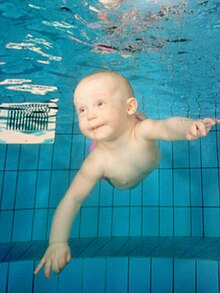
Babies instinctively hold their breath underwater.
Babe pond is the miracle of human babies and toddlers reflexively moving themselves through h2o and changing their rate of respiration and heart rate in response to being submerged. The slowing of heart charge per unit and breathing is called the bradycardic response.[1] Information technology is not true that babies are born with the ability to swim, though they have primitive reflexes that make it await like they are. Babies are not old enough to hold their jiff intentionally or strong enough to keep their head in a higher place h2o, and cannot swim unassisted.
Most infants, though not all, will reflexively hold their breath when submerged to protect their airway and are able to survive immersion in water for brusque periods of fourth dimension.[two] Infants can too exist taken to swimming lessons. Although this may be washed to reduce their risk of drowning, the furnishings on drowning run a risk are not reliable.[3] Babies can imitate swimming motions and reflexes, but are not all the same physically capable of pond.
Infant swimming or diving reflex [edit]
Most human being babies demonstrate an innate swimming or diving reflex from nascence until the age of approximately six months, which are office of a wider range of archaic reflexes constitute in infants and babies, but non children, adolescents and adults. Babies this immature cannot actually swim, yet, due to their overall lack of torso features and forcefulness. Other mammals also demonstrate this miracle (see mammalian diving reflex). This reflex involves apnea (loss of drive to breathe), slowed heart charge per unit (reflex bradycardia), and reduced blood apportionment to the extremities such as fingers and toes (peripheral vasoconstriction).[one] During the diving reflex, the infant's heart rate decreases by an boilerplate of 20%.[one] The glottis is spontaneously sealed off and the water inbound the upper respiratory tract is diverted down the esophagus into the stomach.[4] The diving response has been shown to have an oxygen-conserving effect, both during motion and at residual. Oxygen is saved for the heart and the brain, slowing the onset of serious hypoxic damage. The diving response can therefore be regarded as an of import defence mechanism for the trunk.[5]
Drowning risk [edit]
Drowning is a leading cause of unintentional injury and death worldwide, and the highest rates are amidst children. Overall, drowning is the most common fatal injury among children anile ane–four years in the USA,[six] and is the second highest cause of expiry altogether in that historic period range, later on congenital defects.[7] [eight]
A Centers for Disease Control and Prevention study in 2012 of United states of america data from 2005–2009 indicated that each year an average of 513 children aged 0–4 years were victims of fatal drowning and a further iii,057 of that age range were treated in U.S. hospital emergency departments for non-fatal drowning. Of all the age groups, children aged 0–four years had the highest decease charge per unit and also non-fatal injury rate. In 2013, among children i to 4 years old who died from an unintentional injury, almost 30% died from drowning.[6] These children almost commonly drowned in swimming pools, oft at their own homes.[seven] [8]
Swimming lessons for infants [edit]
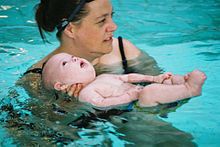
Traditionally, pond lessons started at historic period four years or later, as children under four were not considered developmentally set up.[nine] All the same, swimming lessons for infants have become more common. The Australian Swimming Coaches and Teachers Association recommends that infants can commencement a formal programme of swimming lessons at four months of age and many accredited swimming schools offer classes for very young children, especially towards the beginning of the swimming flavour in Oct.[10] In the United states of america, the YMCA[11] and American Ruby Cross offer swim classes.[12] A babe has to be able to hold his or her head up (usually at 3 to 4 months), to be ready for pond lessons.[13]
Children can be taught, through a series of "prompts and procedures," to float on their backs to breathe, and then to flip over and swim toward a wall or other condom area. Children are essentially taught to swim, flip over and float, then flip over and swim again. Thus, the method is called "swim, float, swim."[14] [15]
Pros and cons of infant swimming lessons [edit]
In a 2009 retrospective case-control study that involved meaning potential sources of bias, participation in formal swimming lessons was associated with an 88% reduction in the take a chance of drowning in ane- to four-twelvemonth-one-time children, although the authors of the study plant the conclusion imprecise.[16] [17] Another report showed that infant swimming lessons may improve motor skills, but the number of study subjects was likewise low to be conclusive.[18]
There may exist a link betwixt infant swimming and rhinovirus-induced wheezing illnesses.[19]
Others have indicated concerns that the lessons might be traumatic, that the parents will take a false sense of security and non supervise immature children adequately around pools, or that the infant could feel hypothermia, suffer from h2o intoxication after swallowing water, or develop gastrointestinal or skin infections.[20] [21]
Professional positions [edit]
In 2010, the American University of Pediatrics reversed its previous position in which it had disapproved of lessons before age four,[9] indicating that the testify no longer supported an informational against early on swimming lessons. Even so, the AAP stated that it found the evidence at that fourth dimension insufficient to back up a recommendation that all 1- to four-year-old children receive swimming lessons. The AAP further stated that in spite of the popularity of swimming lessons for infants under 12 months of age and anecdotal evidence of infants having saved themselves, no scientific study had clearly demonstrated the safety and efficacy of training programs for infants that immature. The AAP indicated its position that the possible do good of early swimming instruction must be weighed against the potential risks (e.m., hypothermia, hyponatremia, infectious illness, and lung damage from pool chemicals).[22]
The American Centers for Disease Control and Prevention recommends pond lessons for children from 1–4, along with other precautionary measures to preclude drowning.[7] [viii] [23]
The Canadian Pediatric Society takes a heart-of-the-road approach. While information technology does non advise against swimming lessons for infants and toddlers, information technology advises that they can non be considered a reliable prevention for drowning, and that lessons for children less than four years should focus on building confidence in the h2o and teaching parents and children water safety skills. They likewise recommend, for all children less than 4 years, abiding arms-length supervision for toddlers most any body of h2o (including bathtubs) and that infants be held at all times.[24]
References [edit]
- ^ a b c Goksor, East.; Rosengren, 50.; Wennergren, G. (2002). "Bradycardic response during submersion in infant swimming". Acta Paediatr. 91 (iii): 307–312. doi:x.1111/j.1651-2227.2002.tb01720.x. PMID 12022304. S2CID 22213714.
- ^ Pedroso, FS (February 2012). "The diving reflex in salubrious infants in the first year of life". Periodical of Child Neurology. 27 (2): 168–71. doi:x.1177/0883073811415269. PMID 21881008. S2CID 29653062.
- ^ Hassal, IB (1989). "Thirty-six consecutive under 5 year old domestic swimming pool drownings". Australian Paediatric Journal. 25 (3): 143–6. doi:x.1111/j.1440-1754.1989.tb01438.x. PMID 2764836. S2CID 31472695.
- ^ Winston, Robert (1998). "The Man Torso". BBC. Retrieved 18 August 2014.
- ^ Alboni, Paolo; Alboni, Marco; Gianfranchi, Lorella (February 2011). "Diving bradycardia: a mechanism of defence against hypoxic impairment". Journal of Cardiovascular Medicine. 12 (6): 422–427. doi:x.2459/jcm.0b013e328344bcdc. PMID 21330930. S2CID 21948366. Retrieved 17 August 2014.
- ^ a b Percentage chart of the causes of decease by unintentional injury, ages one–4 (all races, both sexes), in 2013. Sample size: 1,316. Drowning: 29.9%, motor vehicle traffic accidents: 24.8%, suffocation: 12.two%, burn down/burns: 9.8%, etc. National Centre for Health Statistics (NCHS), National Vital Statistics System.
- ^ a b c Laosee, Orapin C.; Gilchrist, Julie; Rudd, Rose (May xviii, 2012). "Drowning - Us, 2005-2009". Center for Disease Control: Morbidity and Mortality Weekly Report. 61 (19): 344–347. Retrieved eighteen August 2014.
- ^ a b c "Unintentional Drowning: Get the Facts". Centers for Disease Control and Prevention, National Middle for Injury Prevention and Control, Division of Unintentional Injury Prevention . Retrieved xviii August 2014.
- ^ a b American University of Pediatrics, Committee on Sports Medicine and Fitness and Committee on Injury, Violence, and Poison Prevention. (2000). "Swimming Programs for Infants and Toddlers". Pediatrics. 105 (iv pt 1): 868–870. doi:10.1542/peds.105.iv.868 . Retrieved xviii August 2014.
{{cite journal}}: CS1 maint: multiple names: authors list (link) - ^ "Swim Australia FAQs". Archived from the original on 16 Oct 2014. Retrieved 21 September 2014.
- ^ "Parent/Child Swim Lessons (Ages 6-36 months)". New York's YMCA . Retrieved 18 Baronial 2014.
- ^ "Swimming Classes and Water Safety". American Red Cantankerous . Retrieved xviii Baronial 2014.
- ^ Pratt, Sarah. "Baby Pond Classes". Parenting . Retrieved 18 Baronial 2014.
- ^ Principal Judge Babcock (April 16, 2001). "Findings of Fact: Harvey Barnett, Inc. v. Shidler". Courtroom Listener. 143 F. Supp. second: 1247. Archived from the original on 18 August 2014. Retrieved 18 August 2014.
- ^ Court of Appeals for the Tenth Circuit (Aug 15, 2006). "Harvey Barnett, Inc. 5. Shidler". Courtroom Listener. Archived from the original on 18 August 2014. Retrieved 18 August 2014.
- ^ Brenner, RA; Taneja, GS; Haynie, DL; Trumble, AC; Qian, C; Klinger, RM; Klebanoff, MA (Mar 2009). "Association between swimming lessons and drowning in babyhood: a instance-command study". Archives of Pediatrics & Adolescent Medicine. 163 (3): 203–10. doi:10.1001/archpediatrics.2008.563. PMC4151293. PMID 19255386.
- ^ Moreno, MA; Furtner, F; Rivara, FP (Mar 2009). "H2o safety and swimming lessons for children". Athenaeum of Pediatrics & Adolescent Medicine. 163 (iii): 288. doi:x.1001/archpediatrics.2008.572. PMID 19255402.
- ^ Dias, JA; Manoel Ede, J; Dias, RB; Okazaki, VH (Dec 2013). "Airplane pilot study on infant swimming classes and early motor development". Perceptual and Motor Skills. 117 (3): 950–5. doi:10.2466/10.25.PMS.117x30z2. PMID 24665810. S2CID 28391494.
- ^ Schuez-Havupalo, 50; Karppinen, S; Toivonen, L; Kaljonen, A; Jartti, T; Waris, M; Peltola, V (Jul 7, 2014). "Association betwixt infant swimming and rhinovirus-induced wheezing". Acta Paediatrica. 103 (eleven): 1153–1158. doi:10.1111/apa.12736. PMID 25041066. S2CID 20295117.
- ^ Weeks, Carly (July thirteen, 2009). "Water Prophylactic: Can a half dozen-month-old save himself from drowning?". The Globe and Mail . Retrieved xviii August 2014.
- ^ "US babies learn 'cocky-rescue' from drowning". French republic-Presse. July 23, 2011. Retrieved 18 Baronial 2014.
- ^ American University of Pediatrics Committee on Injury, Violence, and Poison, Prevention (Jul 2010). "Prevention of drowning". Pediatrics. 126 (ane): 178–85. doi:ten.1542/peds.2010-1264. PMID 20498166. Retrieved 18 August 2014.
{{cite journal}}: CS1 maint: multiple names: authors list (link) - ^ "Drowning Happens Rapidly– Larn How to Reduce Your Risk". Centers for Affliction Control and Prevention . Retrieved xviii August 2014.
- ^ Hong Nguyen, B (2003). "Swimming lessons for infants and toddlers". Paediatrics and Child Health. viii (two): 113–4. doi:10.1093/pch/8.ii.113. PMC2791436. PMID 20019931.
External links [edit]
- The Diving Reflex - Infant Babies Swimming Underwater on YouTube
- Babe Swimming Resource: Educational activity Progression on YouTube
- Infant Swim Cocky-Rescue on YouTube
Source: https://en.wikipedia.org/wiki/Infant_swimming

Post a Comment for "At What Age Should You Teach a Baby to Swim"